The Kitchen ◆ Fire & Iron
Upside-Down Fire: Why Serious Steakhouses Broil
Grill or double-stack ceramic broiler? Inside the 1,600°F glow that serious steakhouses swear by, and what it does for the crust on your ribeye.
By The Alamo Prime Kitchen5 min read
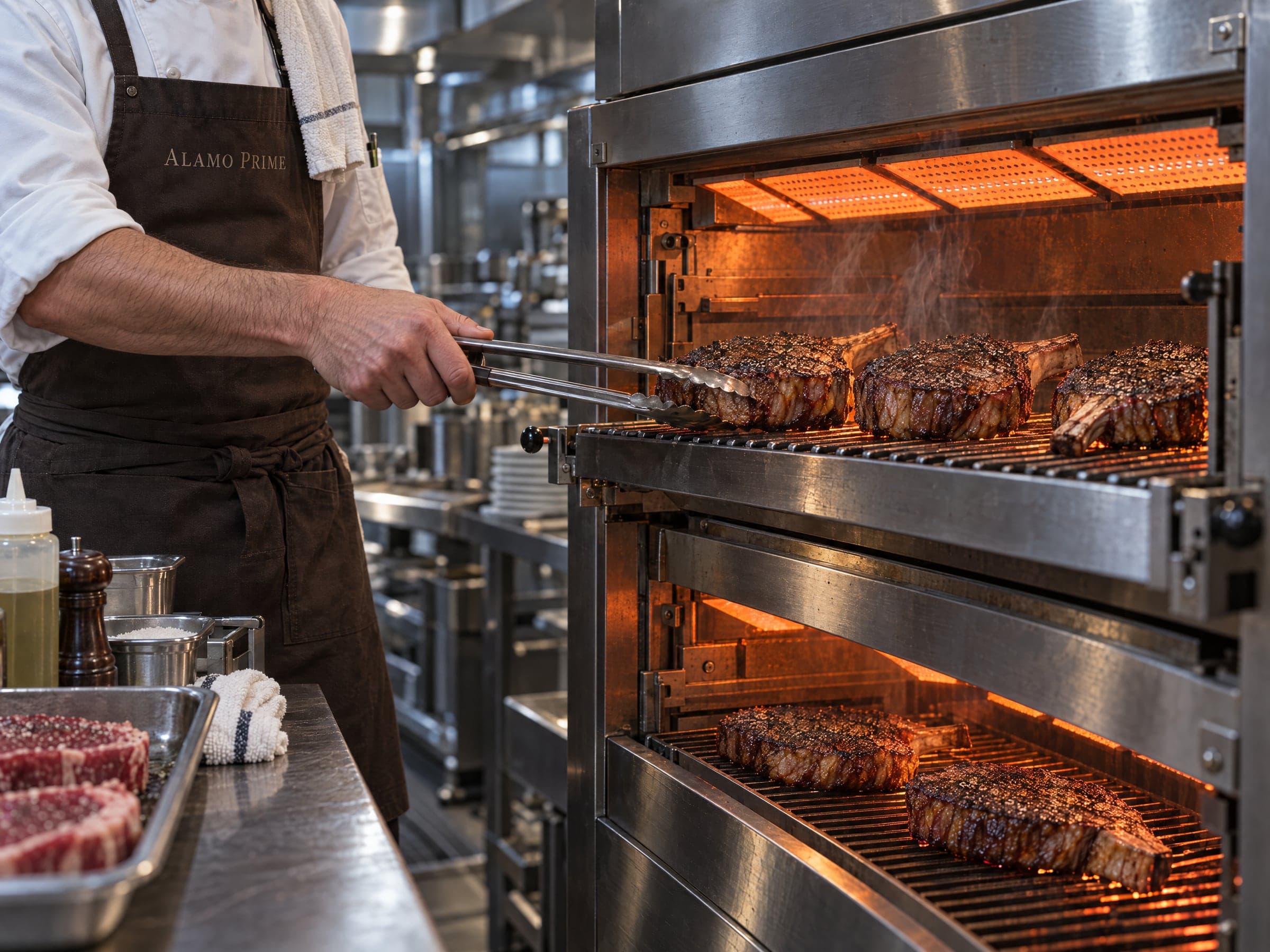
Both decks lit, a few hours before service.
Here is something the backyard would rather you didn’t hear. Some of the best steaks in America never touch a flame. They cook under one, a few inches below a ceiling of ceramic tiles glowing orange at well over a thousand degrees, in a stainless steel box that looks like a filing cabinet somebody set on fire from the inside.
That box is a double-stack ceramic broiler, and our kitchen is built around it. It is loud, it is hot, and it is not especially photogenic next to a wood fire. It is also the reason a steakhouse steak tastes like a steakhouse steak and not like a very good Saturday at your brother-in-law’s.
We love a grill. Texas practically requires it. But when the job is putting the same deep, even crust on a ribeye at 6:15 and at 9:40, on a Tuesday and on a sold-out Saturday, serious steakhouses keep landing on the same answer. Here is why.
A grill cooks a steak. A broiler builds a crust.
The Broiler, by the Numbers
- at the face of the glowing ceramic tiles
- 1,600°F+
- stacked chambers, one cook, two climates
- 2
- rack heights on a typical deck
- 5
- flare-ups, because the fat falls away from the heat
- 0
Chapter 01The Grill
Fire From Below
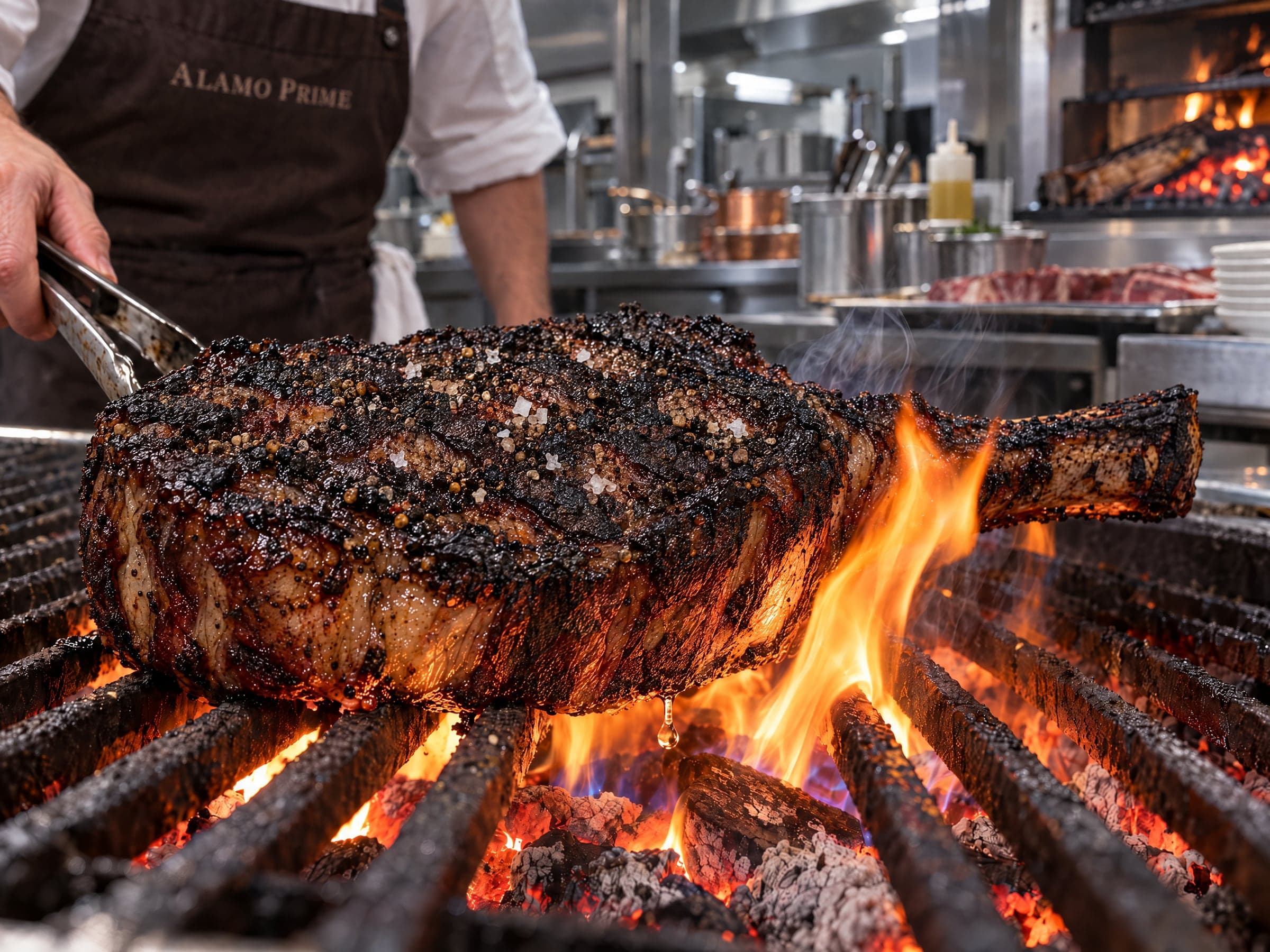
A grill is the oldest idea in cooking: meat over fire. Heat rises from burners, charcoal or wood, runs through the metal bars and into the steak where they touch, and wraps the rest of it in hot air.
It does some things beautifully. Wood and charcoal add real smoke. The bars leave those dark stripes everybody photographs. And there is nothing on earth like standing over live coals with a cold drink in your hand.
It also has habits. A good backyard grill runs somewhere around 500 to 650°F at the grate, with hot spots and cold corners that move every time the wind does. The crust forms where the bars press, so those handsome grill marks are really stripes of crust with paler meat in between. And every drop of rendered fat lands right where the heat lives. It hits the fire, flares up, and coats the steak in whatever the flame decides to send back. Sometimes that is flavor. Sometimes it is soot.
At home, that is character. In a dining room with two hundred tickets, character is another word for variables.
Chapter 02The Broiler
Glow From Above
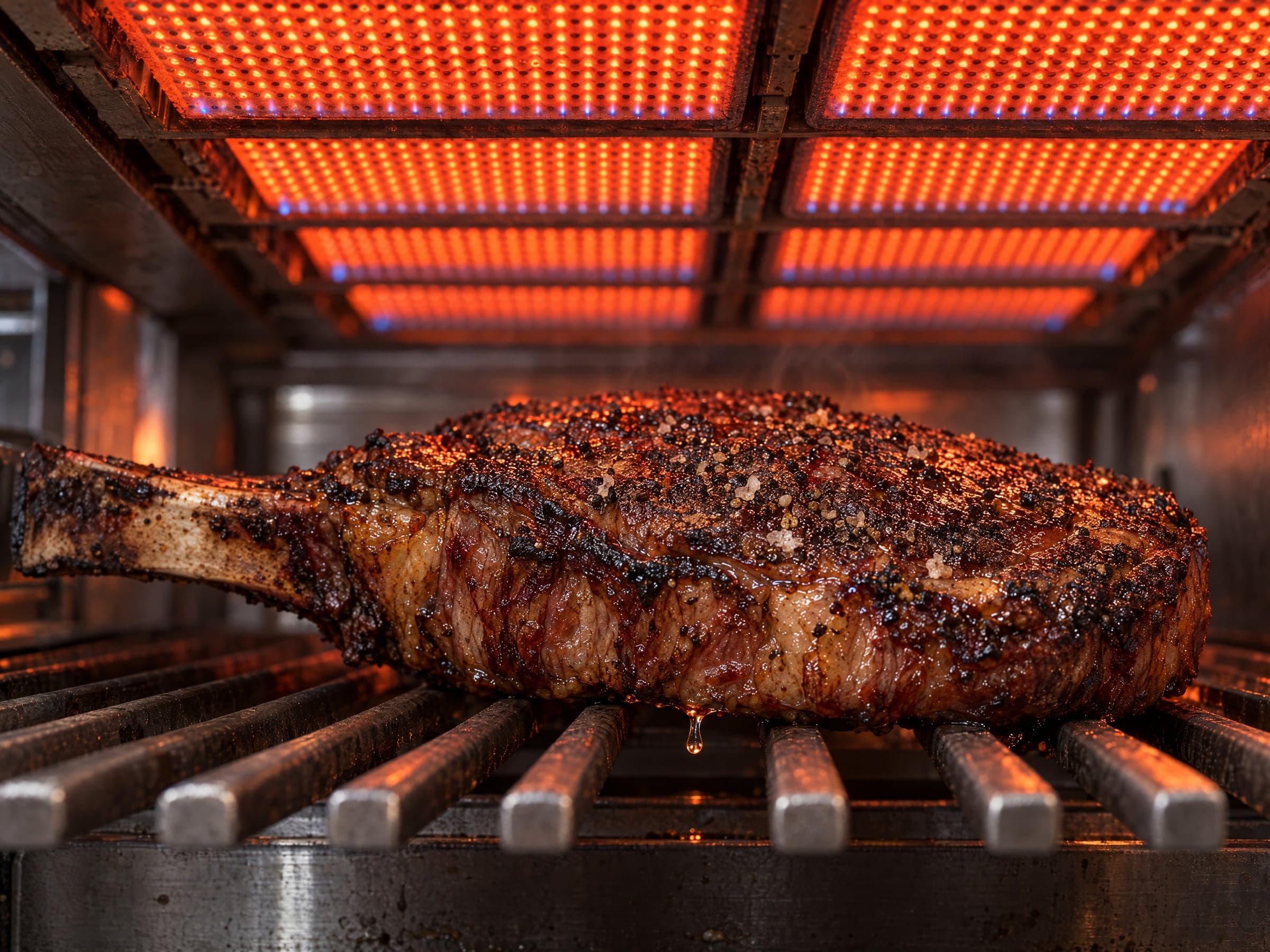
Now flip the whole thing over. In an overfired broiler, the gas burners sit at the top of the chamber, behind rows of ceramic tiles perforated with hundreds of tiny holes. Light the gas and those tiles glow orange from edge to edge. What comes off them is mostly infrared: radiant heat that travels in a straight line and lands on the surface of the steak all at once, instead of heating up the air around it and hoping for the best.
Below the glow sits a heavy steel grid on a spring-balanced rack. The cook slides it out, loads the steaks, and slides it back under the tiles. Want more intensity? Raise the rack closer to the heat. Thick cut that needs time to cook through without scorching? Drop it a notch or two. That rack height is the broiler’s steering wheel, and a good broiler cook drives it without looking.
Then there is the fat. Under a broiler, rendered fat drips down, away from the heat, into a grease drawer. No flare-ups. No soot. No mystery smoke. What you taste is the beef, the salt, the pepper and the crust, which is the whole point of paying for great beef in the first place.
Chapter 03The Double Stack
Two Decks, Two Climates
A double-stack broiler is exactly what it sounds like: two broiling chambers, one on top of the other, each with its own burners, its own grid and its own controls. Tall enough to work at chest height, compact enough to fit on a line that is already fighting for every inch.
The obvious reason for the second deck is volume. A full dining room orders a lot of steak at the same time, and two decks means twice the grid. But the better reason is control. Two chambers can run two different ways at once. One can roar for a hard, fast crust on a strip. The other can be set to give a thick cut like the 36 oz. TX Wagyu Tomahawk the patience it needs, so the center arrives warm and rosy while the outside stays dark instead of burnt.
There is one more quality you only appreciate in the middle of a rush: recovery. Slide a grid of cold steaks under a backyard lid and the temperature drops and crawls back. Ceramic tiles hold an enormous amount of heat, and commercial broilers are built to bounce back fast. The tenth steak of the night and the two hundredth go under the same glow.
Chapter 04The Crust
Speed Is Flavor
Every great steak is a race between two things. On the outside, you want browning, and you want a lot of it. On the inside, you want the meat to barely move past the temperature you ordered. The longer the outside takes to brown, the more heat soaks inward in the meantime, and the thicker that grey band gets.
This is where 1,600 degrees earns its keep. Radiant heat that intense puts a crust on a steak in the time a grill is still thinking about it. Because the heat lands across the entire top surface instead of along a few steel bars, the crust is continuous: dark, crackling and even, corner to corner. Slice it and you see a thin dark edge, then red and pink almost all the way through.
A grill can get you close on a good night. A broiler gets you there on purpose.
Head to Head
The Grill
The Broiler
- Heat source
- Flame or coals below the steak
- Ceramic tiles glowing above the steak
- Top heat
- Roughly 500 to 650°F on a good backyard grill
- North of 1,600°F at the tiles
- Crust
- Stripes where the bars touch
- Even, edge to edge
- Fat
- Drips into the fire and flares up
- Falls away into a grease drawer
- Flavor
- Smoke, char, a little chaos
- Beef, salt, pepper, crust
- Control
- Move the steak between hot and cool spots
- Raise or lower the rack
- On a Saturday night
- Every steak cooks a little differently
- The two hundredth steak matches the first
The grill is romance. The broiler is a promise.
Chapter 05The Choice
Why Serious Steakhouses Broil
Walk into the kitchen of almost any old-school American steakhouse and look past the romance of the dining room. There is a very good chance the steaks are going under a stainless steel broiler. The reasons are not mysterious.
Consistency. A broiler does the same thing at the same rack height, every time. Medium rare at table 12 looks exactly like medium rare at table 40.
Speed. High radiant heat means crust in minutes, so the steak spends less time cooking and more time on your table while it is still sizzling.
Capacity. One cook, two decks, a grid full of steaks. That is how a busy dining room gets its entrées together instead of in waves.
Clean flavor. No flare-ups means no soot and no bitter char. When you have spent real money and real time sourcing great beef, you want the beef to do the talking.
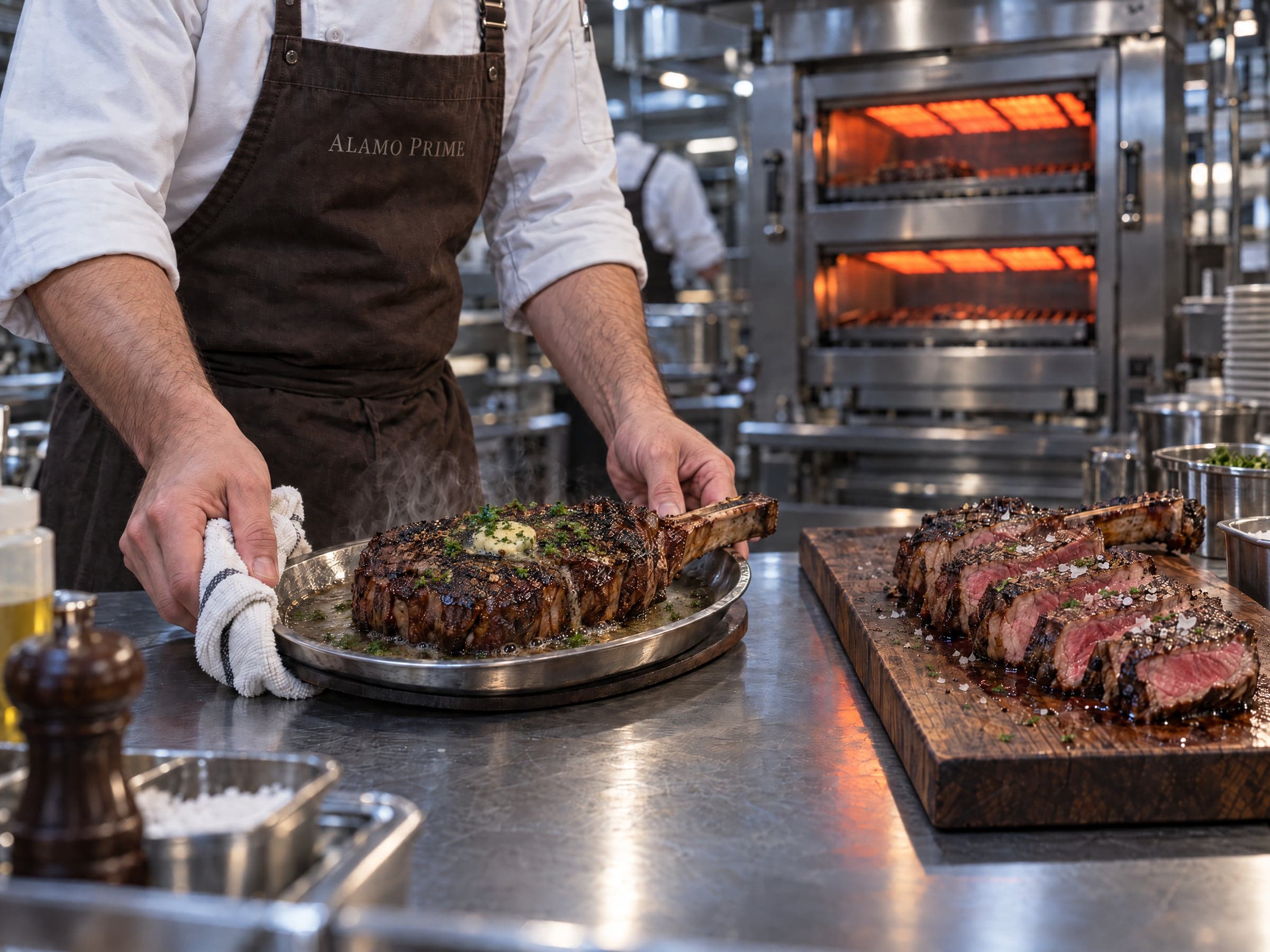
And then there is the finish. A steak off the broiler goes onto a platter that is already screaming hot, gets a coin of Cowboy Compound Butter that melts into the crust on the way to your table, and arrives still hissing. Yes, the sizzle is a bit of showmanship. It also means your steak has not had a chance to cool down.
Take It Home
Broil Like You Mean It
You do not need a 1,600 degree broiler at home. You need the one already in your oven and a little nerve.
Dry it, salt it
Pat the steak completely dry. Salt it generously at least 45 minutes ahead, or right before it cooks. A wet surface steams instead of browning.
Preheat everything
Set a cast iron skillet on the top rack and run the broiler on high for a good ten minutes. The pan sears from below while the element works from above.
Mind the gap
Position the rack so the top of the steak sits about three to four inches from the element. Closer is faster and riskier. That is your rack height.
Flip once
Broil until the top is deeply browned, then flip and do the other side. Leave the door cracked if your oven cycles the broiler off when it gets hot.
Trust a thermometer
Pull the steak about five degrees before your target. For medium rare, take it off around 125°F and let carryover do the rest.
Rest and butter
Five minutes on a warm plate with a spoonful of good butter on top. Then slice against the grain and do not share unless you have to.
That is the whole secret, and it was never really a secret. Great beef, serious heat from the right direction, and people who know when to pull it. The grill will always have our heart. The broiler has our crust.
Grand Opening
Come Hear the Sizzle
On the board
- 7 oz. Filet
- 10 oz. Strip
- 12 oz. Ribeye
- 8 oz. Picanha
- 10 oz. Texas Wagyu Skirt Steak
- 36 oz. TX Wagyu Tomahawk
- 14 oz. Double Cut Pork Chop
- Double Cut Colorado Lamb Chops
- Red Chile Braised Short Rib
- Pork Spareribs